
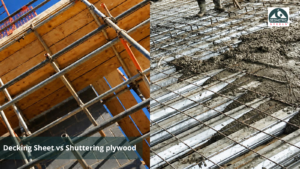
Quick answer: Shuttering plywood is temporary formwork: cheap to buy, reusable a limited number of times, but slow to erect and strip, and it needs props and separate bottom reinforcement. A decking sheet is permanent steel formwork: it costs more as material but stays in the slab as reinforcement, needs no stripping, and is much faster on steel-framed buildings. For steel frames, decking usually wins on total cost; for RCC frames, plywood remains the practical default.
The real question contractors are asking
“Plywood is cheaper per sheet, so why pay for steel?” It is a fair question. The answer lies in what each material does, how many times you handle it, and how many days it keeps a floor tied up.
What each option actually does
Shuttering plywood
A temporary mould. It is held up by props and runners, receives the concrete, and is removed once the slab gains strength. Bottom reinforcement bars are tied separately on top of it.
Decking sheet
A profiled galvanized steel sheet that spans between steel beams. It holds the concrete during the pour and then stays in place, bonding with the concrete through embossments so it acts as the slab’s bottom reinforcement. It is designed under IS 11384:2022 as part of a composite slab.
Side-by-side comparison
| Factor | Decking sheet | Shuttering plywood |
| Role | Formwork + permanent reinforcement | Temporary formwork only |
| Removal | Not removed | Stripped after concrete gains strength |
| Reuse | Single use, stays in the building | Reused a limited number of cycles; quality drops each time |
| Props | Often avoided within the sheet’s design span | Needed under the full slab |
| Bottom reinforcement | Largely provided by the sheet | Separate bars tied on site |
| Speed | Fast laying; no strip cycle | Slower; erect, pour, wait, strip |
| Weather | Galvanized steel unaffected by monsoon | Swells and degrades with moisture |
| Site safety | Firm working platform once fixed | Depends on prop system and workmanship |
| Waste | Cut-to-length, minimal offcuts | Damaged sheets discarded after cycles |
General comparison only. Actual outcomes can vary by client requirement, structural design, site conditions and location.
The cost equation
Compare per square metre of finished slab, not per sheet:
Plywood route = plywood (÷ number of reuses) + props & runners + erection labour + stripping labour + bottom rebar + (days of formwork cycle × cost of delay)
Decking route = decking sheet + fixing labour + props (only if required) + (fewer days × cost of delay)
Plywood looks cheaper until you add the labour it takes to put up and take down, the bottom bars it cannot replace, and the days the floor waits. Decking puts more money into material and less into labour and time. On a steel-framed factory, warehouse or commercial building, that trade usually favours decking. For current material rates, see our decking sheet price guide.
Monsoon and site conditions
Plywood absorbs moisture, warps and delaminates, and this gets worse in the Indian monsoon. Galvanized decking is dimensionally stable and can be stocked on site, although bundles should still be stored off the ground, covered and ventilated to avoid white rust.
When plywood is still the right call
- The building has an RCC frame with no steel beams to support a deck.
- The contractor owns a large formwork inventory with plenty of reuses left.
- The slab has complex shapes, many level changes or irregular openings that don’t suit a profiled deck.
Made in Pune, supplied across India
Geometric Steels manufactures SteelDECK composite decking at its ISO 9001:2015 certified plant in Kurkumbh MIDC, Pune, with CE marking on applicable products. Our 20+ years in roll forming include supply to infrastructure such as Samruddhi Mahamarg and the Z-Morh Tunnel.
Frequently asked questions
1) Can decking sheet replace shuttering plywood?
Yes, on steel-framed buildings. It holds the wet concrete between beams, so no plywood is needed, and it stays in place as bottom reinforcement.
2) Is decking sheet reusable like plywood?
No. It is permanent formwork and becomes part of the slab.
3) Which is cheaper?
Plywood is cheaper as material, but decking removes stripping labour, much of the propping and bottom rebar, and saves time. On steel frames, total cost often favours decking.
4) Can decking sheet be used on an RCC-framed building?
It needs supporting beams, typically steel. Without them, conventional shuttering is usually the practical choice.