| Quick answer: What is a decking sheet?
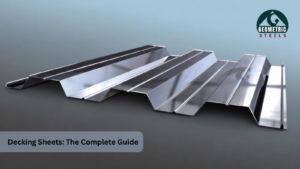
A decking sheet (also called a deck sheet, metal deck or composite deck sheet) is a profiled, galvanised steel sheet laid over steel beams to form floors and roofs. Concrete is poured on top of it. The sheet works as permanent formwork, so no plywood shuttering is needed, and in a composite slab it also acts as the bottom reinforcement of the concrete. Decking sheets are widely used in multi-storey steel buildings, mezzanine floors, commercial complexes and industrial structures. |
If you are planning a steel-framed building in India, decking sheets are one of the fastest and most economical ways to build its floors. Yet buyers often get confusing information about profiles, thickness and pricing. This guide explains everything in plain language: what decking sheets are, how they work, which profile to choose, how they are installed and what affects their cost.
Note: in this guide, “decking sheet” means a steel floor or roof deck used in construction. It is different from wooden or WPC decking used for gardens and terraces.
Key Facts About Decking Sheets
| • Material: galvanised (zinc-coated) steel, roll-formed into a ribbed profile.
• Main job: permanent formwork for a concrete slab, plus tensile reinforcement in composite slabs. • Common profile depths: Geometric Steels manufactures SteelDECK44 mm, SteelDECK52 mm, SteelDECK76 mm and SteelDECK102 mm. • Typical thickness: 0.80 mm to 1.20 mm, chosen by the structural engineer based on span and load. • Cover width: 1030 mm for SteelDECK52, among the widest in its class, so fewer sheets cover the same floor area. • Supported on: steel beams (and sometimes RCC or masonry supports) with a concrete topping poured on site. • Main benefits: faster construction, no shuttering, fewer props, less concrete than a solid slab and a clean ceiling finish. • Installation speed: one crew can install over 350 m² of decking per day, depending on the building. • Proven use: Geometric Steels has supplied 53,000 m² of SteelDECK76 to the Samruddhi Mahamarg (Mumbai–Nagpur Expressway) since June 2021. |
How Does a Decking Sheet Work?
A decking sheet does two jobs at two different stages of construction:
- During construction: the sheet is fixed to the steel beams and acts as a working platform and permanent formwork. It carries the weight of the wet concrete, workers and equipment until the concrete hardens.
- After the concrete hardens: the steel sheet and the concrete work together as one composite slab. The steel at the bottom acts as the positive-moment (tension) reinforcement, and the concrete on top takes the compression. The two materials are locked together by embossments rolled into the webs and flutes of the deck, which create the shear bond.
When the slab is also connected to the steel beams using shear studs, the beam and slab act together too. This “composite construction” lets designers use lighter beams for the same load.
Types of Decking Sheets
1. Composite floor decking sheets
The most common type. The sheet stays in place permanently and works together with the concrete as reinforcement. Used for floors in multi-storey steel buildings, commercial complexes, hospitals, malls and parking structures.
2. Non-composite (formwork) decking sheets
Here the sheet acts only as permanent formwork. The concrete slab is designed with its own full reinforcement, and the deck is not counted as part of the slab’s strength.
3. Roof decking sheets
Decking sheets are also used as structural roof decks, either under a concrete topping or as a base for insulation and waterproofing layers on flat roofs.
Shallow vs deep profiles
Decking sheets are also grouped by rib depth. Shallow profiles (around 44 mm to 52 mm) suit smaller and normal floor spans and mezzanines. Deeper profiles (75 mm to 100 mm and above) are stiffer, so they can generally span further between beams and reduce the number of secondary beams or temporary props.
Geometric Steels SteelDECK Profiles and Specifications
Geometric Steels manufactures four SteelDECK profiles at its plant in Kurkumbh MIDC, Pune, named by crest height: SteelDECK44, SteelDECK52, SteelDECK76 and SteelDECK102. All are zinc-coated galvanised steel profiles supplied in custom lengths, and suitable for steel-frame, concrete or masonry supported construction.
1) SteelDECK44
The compact, lightweight member of the range, with a 44 mm crest. It is suited to applications where a relatively shallow deck profile is required, such as site offices, small mezzanines and short spans, and offers fast, low-labour installation with zinc-coated corrosion resistance.
2) SteelDECK52
The best-in-class profile for general floors, with a 1030 mm cover width, among the widest effective cover widths in the industry, so fewer sheets cover the same area. It has a 52 mm crest and comes in 0.80 mm to 1.20 mm total coated thickness (TCT). It carries wet concrete, construction and storage loads and allows several floors to be cast at the same time.
3) SteelDECK76
Offers a very high cover per kg of steel, which makes it economical for a wide range of construction. It is used in multi-storey industrial and residential buildings, shopping malls, supermarkets, SEZs, silos, storage facilities, mezzanines, bridges, walkways and platforms. It can also be used as cover and cladding sheets in cement plants, power plants and bulk-material handling plants. SteelDECK76 is the profile supplied to the Samruddhi Mahamarg expressway (see the case study below).
4) SteelDECK102
Specially introduced for larger spans. Its high 102 mm crest gives large spanning capacity, which leads to savings in joists and secondary beams. It is a strong, practical choice as sacrificial shuttering where spans are long.
| Specification | SteelDECK44 | SteelDECK52 | SteelDECK76 | SteelDECK102 |
| Crest height | 44 mm | 52 mm | 76 mm | 102 mm |
| Cover width | On request | 1030 mm | As per profile drawing | As per profile drawing |
| Material | Galvanised steel | Galvanised steel | Galvanised steel | Galvanised steel |
| Thickness (TCT) | On request | 0.80 to 1.20 mm | 0.80 to 1.20 mm | 0.80 to 1.20 mm |
| Yield strength | On request | 245 or 350 MPa | 245 or 350 MPa | 245 or 350 MPa |
| Zinc coating | As per IS 277 | As per IS 277 | As per IS 277 | As per IS 277 |
| Key strength | Compact, lightweight | 1030 mm cover, best in class | High cover per kg of steel | Largest spans, fewer joists |
| Typical use | Site offices, small spans | Floors, mezzanines, roof decks, flyovers & rail overbridges | Multi-storey, malls, silos, infrastructure,, flyovers & rail overbridges | , flyovers & rail overbridges ,Long-span floors |
Thickness, yield strength and profile are confirmed against the structural design for each project. Contact Geometric Steels for other thickness and grade requirements.
Decking Sheet Size and Thickness: How to Choose
Decking sheet size is described by four numbers. Here is what each one means:
| Term | What it means |
| Crest height (profile depth) | The height of the ribs, e.g. 52 mm. Deeper ribs make the sheet stiffer. |
| Cover width | The effective width each sheet covers after side laps, e.g. 1030 mm. Used to calculate the number of sheets. |
| Thickness (TCT / BMT) | TCT is the total coated thickness including zinc; BMT is the base metal thickness of the steel alone. |
| Length | Sheets are roll-formed to the length needed for the beam layout, which reduces site cutting and waste. |
| Yield strength | The stress the steel can take before permanent bending, e.g. 245 MPa or 350 MPa. |
The right profile and thickness depend on:
- Span between beams: longer spans generally need a deeper profile or a thicker sheet.
- Floor load: offices, warehouses, plant rooms and parking floors carry very different loads.
- Slab depth and concrete grade: these set the weight the deck must carry during the pour.
- Fire rating: the required fire resistance can affect slab depth and reinforcement.
- Propping: whether temporary props can be used during concreting, or the deck must span unpropped.
Your structural engineer selects the profile and thickness, typically using Indian standards such as IS 800 and IS 11384, or international codes such as Eurocode 4. The manufacturer then supplies sheets matching that design.
Decking Sheet vs Conventional RCC Slab
| Factor | Decking sheet (composite slab) | Conventional RCC slab |
| Formwork | None; the sheet is permanent formwork | Plywood or steel shuttering needed |
| Propping | Few or none, depending on span | Full props until concrete gains strength |
| Construction speed | Fast; several floors can progress together | Slower; each floor waits for de-shuttering |
| Concrete quantity | Lower, because the ribs reduce slab volume | Higher for a solid slab |
| Reinforcement | Deck acts as bottom reinforcement; mesh on top | Full bottom and top steel bars |
| Site work | Clean, dry and less labour-intensive | More labour, material handling and waste |
| Ceiling finish | Neat ribbed steel finish, can be left exposed | Needs plastering or a false ceiling |
| Best suited for | Steel-framed and PEB buildings | RCC-framed buildings |
Where Are Decking Sheets Used?
- Commercial buildings: offices, IT parks, shopping malls, supermarkets and cinemas.
- Industrial buildings and warehouses: mezzanine floors, plant rooms, platforms, silos and storage facilities.
- Infrastructure: expressways, bridges, walkways and SEZs.
- Public buildings: hospitals and schools.
- Housing: individual houses and residential buildings.
- Refurbishment projects: adding a new floor or mezzanine inside an existing building, where a light, fast floor system is needed.
Benefits of Decking Sheets
- Speed of construction: sheets are lifted in bundles by crane and fixed by hand. One crew can install over 350 m² of decking per day, depending on the shape and size of the building, and floors can be concreted in rapid succession.
- No plywood shuttering: the deck is permanent formwork, saving shuttering material, labour and site waste.
- Lighter floors: the ribbed profile cuts concrete volume and slab weight, which can reduce the size of beams, columns and foundations.
- Shallower construction, more headroom: composite beams can be shallower than non-composite beams for the same span and load, giving lower floor-to-floor heights or extra space for services.
- Lower transport cost: sheets come in pre-cut lengths, tightly bundled. A single truck can typically carry more than 1,000 m² of decking, so fewer deliveries are needed.
- Safety: the fixed deck acts as a secure working platform and a safety canopy that protects workers below from falling objects.
- Structural stability: properly fixed decking gives lateral restraint to beams during construction, and the finished composite slab acts as a diaphragm in the building.
- Easy services installation: cable trays, pipes, false ceilings and ventilation equipment can be hung from the deck using hangers.
- Sustainability: steel can be recycled without losing its properties, and composite construction uses materials efficiently.
- Durable: zinc coating as per IS 277 protects the steel against corrosion.
Case Study: 53,000 m² of SteelDECK76 for Samruddhi Mahamarg
| Samruddhi Mahamarg, the 701 km Mumbai–Nagpur Expressway, is one of the Maharashtra Government’s most ambitious infrastructure projects. Since June 2021, Geometric Steels has supplied 53,000 square metres of SteelDECK76 steel decking sheets to the project, supported by a manufacturing setup dedicated to it.
The project shows how decking sheets support fast, large-scale construction where speed, consistency of supply and quality are critical. |
How Are Decking Sheets Installed?
A typical installation follows these steps (always follow the approved structural drawings):
- Check the steel frame: beams must be level, aligned and their top flanges clean, especially where shear studs will be welded.
- Lay the sheets: place sheets with ribs running across (perpendicular to) the supporting beams, starting from one end and overlapping side laps correctly.
- Fix the sheets: fasten to the beams with self-drilling screws, shot-fired pins or welds, and stitch the side laps together.
- Install temporary props if required: only where the design span is more than the deck can carry unpropped.
- Weld shear studs: for composite beams, studs are welded through the deck to the beam top flange.
- Fix edge trims: pour-stop trims are fixed at slab edges and openings to hold the concrete.
- Place reinforcement: lay the mesh and any extra bars specified in the design.
- Pour and cure the concrete: spread the concrete evenly without heaping it in one spot, then cure as specified.
What Affects the Price of Decking Sheets?
Decking sheets in India are usually quoted per kg, per running metre or per square metre. The final price depends on:
- Thickness: the biggest factor, since thicker sheets use more steel per square metre.
- Profile: deeper profiles use more steel per square metre of floor covered.
- Steel grade and coating: higher yield strength and heavier zinc coating cost more.
- Steel market prices: coil prices change often, so quotes are usually valid for a limited period.
- Quantity and lengths: larger orders and cut-to-length sheets improve the per-unit cost and reduce waste.
- Accessories: edge trims, flashings, fasteners and shear studs.
- Transport and taxes: freight to site and GST.
For an accurate quote, share your floor area, beam layout or drawings, required thickness and site location with the manufacturer.
Common Mistakes to Avoid
- Choosing thickness based on price alone instead of the structural design.
- Laying sheets with ribs in the wrong direction relative to the beams.
- Skipping props on spans that exceed the deck’s unpropped limit.
- Dumping concrete in one heap, which can overload and bend the sheet.
- Poor fixing at side laps and edges, causing concrete leakage during the pour.
- Buying from unverified suppliers without mill test certificates or coating details.
Why Choose Geometric Steels for Decking Sheets?
Geometric Steels is an ISO 9001:2015 and CE certified manufacturer of decking sheets, roofing sheets and steel building components, based at Kurkumbh MIDC, Pune. With over 20 years of experience and exports to 7+ countries, Geometric Steels supplies SteelDECK44, SteelDECK52, SteelDECK76 and SteelDECK102 profiles, roll-formed to project lengths, to builders, PEB companies and contractors across India.
- Proven at scale: 53,000 m² of SteelDECK76 supplied to Samruddhi Mahamarg.
- Trusted by industry: decking customers include Renault Nissan Automotive (Oragadam Industrial Corridor, Chennai), INA Bearing (Pune) and Jabil Circuit (Pune).
- Standard and custom profiles: standard designs delivered quickly, plus custom-designed decks for specific needs.
- Transparent facts: the specifications we publish are our own product data.
Frequently Asked Questions About Decking Sheets
1) What is a decking sheet?
A decking sheet is a profiled galvanised steel sheet fixed on steel beams, on which concrete is poured to form a floor or roof slab. It works as permanent formwork and, in a composite slab, as the bottom reinforcement.
2) What is the thickness of a decking sheet?
Decking sheets are commonly made in 0.80 mm to 1.20 mm thickness. The correct thickness is chosen by the structural engineer based on span, load and slab depth.
3) What is the standard size of a decking sheet?
Size depends on the profile. Geometric Steels SteelDECK sheets come in crest heights of 44 mm, 52 mm, 76 mm and 102 mm (SteelDECK52 has a 1030 mm cover width), and are cut to the length required by the beam layout.
4) What is the difference between a decking sheet and a roofing sheet?
A roofing sheet is a thin, colour-coated sheet that forms the outer weather covering of a roof. A decking sheet is a thicker, deeper structural sheet that supports a concrete slab and carries floor loads.
5) Where are decking sheets used?
They are used for floors and roofs in multi-storey steel buildings, mezzanine floors, warehouses, industrial plants, metro stations, hospitals, malls and multi-level parking structures.
6) Is a decking sheet slab cheaper than an RCC slab?
In steel-framed buildings it is often more economical overall, because it removes shuttering, reduces props, uses less concrete and speeds up construction. The actual saving depends on the project design.
7) Do decking sheets need props during concreting?
Not always. Within the design span, the deck can carry the wet concrete unpropped. For longer spans, temporary props are placed until the concrete gains strength.
8) Which decking sheet profile is best for long spans?
Deeper profiles span further. Among Geometric Steels profiles, SteelDECK102, with a 102 mm crest, is designed for larger spans and reduces the number of joists. SteelDECK44 suits short spans and shallow-profile needs, SteelDECK52 suits typical floor spans, and SteelDECK76 sits in between with a high cover per kg of steel.
9) What is the difference between a 44 mm and a 52 mm decking sheet?
The main difference is crest height and rib geometry. A 44 mm deck such as SteelDECK44 is a compact, shallow profile suited to small spans and light-duty floors like site offices. A 52 mm deck such as SteelDECK52 is the general-purpose choice for most floors and mezzanines, and its 1030 mm cover width means fewer sheets per floor. The final choice should come from the structural design, not crest height alone.
10) Who manufactures decking sheets in India?
Several roll-forming companies make decking sheets in India. Geometric Steels, an ISO 9001:2015 and CE certified manufacturer based at Kurkumbh MIDC, Pune, makes SteelDECK44, SteelDECK52, SteelDECK76 and SteelDECK102 profiles and has supplied 53,000 m² of decking to the Samruddhi Mahamarg expressway.
11) How long do decking sheets last?
Inside a building and protected by the concrete above, a properly zinc-coated decking sheet is designed to last for the life of the structure, provided it is not exposed to continuous moisture or chemicals.
| Need decking sheets for your project?
Send your floor area, beam layout and required profile to Geometric Steels for technical support and a quotation for SteelDECK44, SteelDECK52, SteelDECK76 or SteelDECK102. Call +91 855099 5556 or email roof@geometricsteels.com. Factory: Plot E-21, Kurkumbh MIDC, Pune–Solapur Road, Daund, Pune 413802. Business hours: Monday to Saturday, 10 am to 7 pm. |